
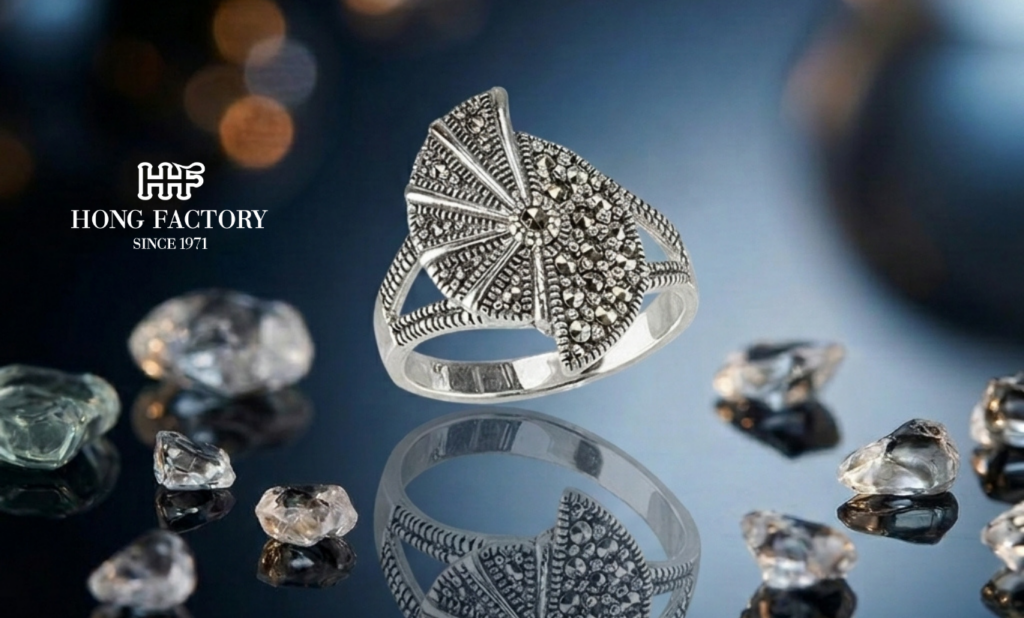
Walk the floors of any major jewelry trade show this season — Paris, Las Vegas, Bangkok — and the message is unmistakeable. The fluid, organic silhouettes that defined the jewelry aesthetic of the last several years are giving way to something crisper, more precise, more architecturally intentional. The hexagon is everywhere. The chevron is back. The fan drop earring, the geometric pendant, the step-cut baguette arrangement — the entire visual vocabulary of Art Deco is reasserting itself with a force and confidence that makes “trend” feel like an inadequate word.
This is not a trend. It is a return.
Antique silver jewelry in the Art Deco tradition has never truly been absent — the decade-proof commercial performance of geometric marcasite pieces is well documented by anyone who has tracked wholesale sell-through data over time. But what 2026 has done is elevate Art Deco from a consistent performer to a cultural moment. Fashion editorials are referencing the period directly. Runway designers from Paris to Seoul are working geometric precision into their jewelry presentations. The broader fashion conversation about “quiet luxury” and considered aesthetics has created the perfect cultural environment for Art Deco’s particular kind of beauty to be rediscovered by an entirely new generation.
And at the centre of this revival — as it has been since the tradition was first translated into silver and stone in Bangkok’s workshops — is vintage marcasite jewelry. This is its moment.
What Art Deco Was, and Why It Matters Now
The Original Modernist Jewelry
The Art Deco movement emerged in Paris in the early 1920s and spread with extraordinary speed through every field of design — architecture, furniture, fashion, film, and jewelry — before reaching its cultural apex around 1930 and gradually yielding to the more austere aesthetics of the Depression era.
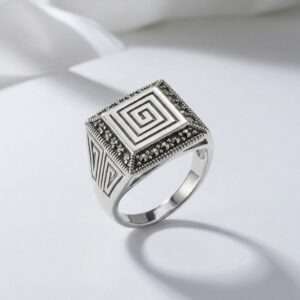
Art Deco was a conscious break from what preceded it. Where Art Nouveau (the dominant design movement of the preceding two decades) had celebrated organic, flowing, nature-inspired forms — curves, vines, flowers, feminine figures dissolving into decorative flourishes — Art Deco celebrated the opposite. Straight lines. Geometric precision. Symmetry. The marriage of fine craft skill with the machine aesthetic that the new industrial age embodied.
In jewelry specifically, Art Deco meant the integration of contrasting materials in architectural settings, the use of geometric motifs as primary design elements, and a palette built on tonal contrast — platinum and white gold, diamonds and onyx, the cool and the dark set against each other in compositions of maximum visual precision.
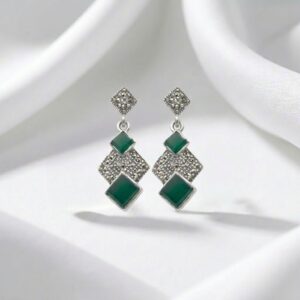
Sterling silver jewelry from Thailand in the Art Deco tradition translates this same aesthetic into a different material register. The platinum of the 1920s becomes oxidised 925 sterling silver. The diamonds become marcasite — the dark, metallic sparkle that creates the same tonal contrast without the price of the original. The architectural settings become the hand-set pavé of Bangkok’s craftspeople, who learned to produce the geometric precision of Art Deco in silver as fluently as their predecessors had in platinum.
The result is not a reproduction of Art Deco jewelry. It is a living continuation of the same aesthetic tradition — one that Hong Factory has been part of since 1971, and that 2026 is recognising with new urgency.
The Cultural Conditions for the Revival
Art Deco revivals are not random. They happen when the cultural conditions that produced the original are, in some meaningful way, being recreated. Understanding why 2026 is an Art Deco moment helps contexualise the aesthetic rather than simply chasing it.
The precision reaction. After several years of maximalist, organic, and deliberately imprecise jewelry design — irregular stone shapes, asymmetric compositions, the cultivated rough and unpolished aesthetic — there is a readiness for precision. Art Deco’s extreme geometric control is the polar opposite of the organic maximalism that preceded this moment. The swing of aesthetic preference is operating exactly as it always has.
The silver moment. Gold dominated the jewelry conversation for most of the 2010s and early 2020s. Silver is in definitive resurgence, driven partly by its compatibility with the cooler, more restrained styling of quiet luxury and partly by a generation of buyers who associate gold with the aesthetic excesses of the previous decade. Art Deco is fundamentally a silver-and-platinum aesthetic — its return is inseparable from silver’s return.
The “new intellectual” consumer. The buyer who is driving Art Deco’s 2026 revival is design-literate, historically aware, and interested in jewelry that communicates aesthetic intelligence. They know what the hexagon means in an Art Deco context. They can place a chevron band or a step-cut arrangement in its historical tradition. This cultural knowledge is more prevalent now than at any previous point in the mainstream jewelry market — a consequence of the design education that social media, museum culture, and the digitisation of visual history have made universally accessible.
The Visual Grammar of Art Deco: A Field Guide
To buy Art Deco vintage marcasite jewelry well — or to wear it well, or to sell it well — you need to be fluent in its visual grammar. Here are the key elements.
The Hexagon
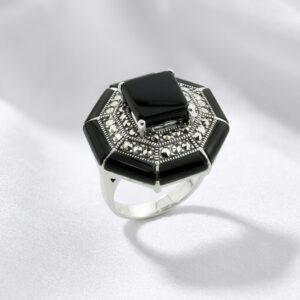
The hexagon is the signature motif of Art Deco jewelry. Its six equal sides create a form that is both geometric and somehow organic — the hexagon appears in nature (honeycomb, snowflakes, crystal structures) in a way that the pure right angle does not, which gives it a resonance beyond simple geometry.
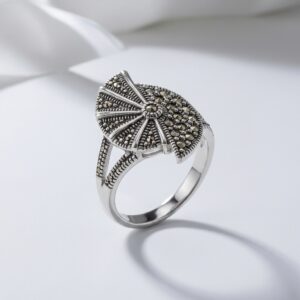
In marcasite jewelry, the hexagonal cluster — a hexagonal frame of densely set pavé stones — is the most immediately recognisable Art Deco form. It appears in rings, pendants, earrings, and brooches. At any scale from a modest stud to a substantial cocktail ring, the hexagon communicates the period with complete specificity.
The Fan and the Chevron
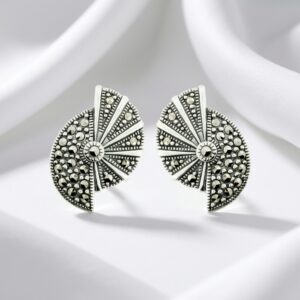
The fan — a semicircular form spreading outward from a fixed point — and the chevron — a V-shaped or inverted V arrangement — are the two most dynamic motifs in the Art Deco vocabulary. Where the hexagon is static and anchored, the fan and chevron suggest movement and direction.
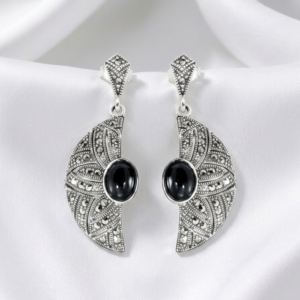
Fan drop earrings use this dynamic quality to create a strong facial silhouette — the spreading form of the fan echoing and amplifying the jaw and cheekbone below. Chevron rings use it to create a strongly directional linear emphasis across the finger, making the hand appear more elegant and elongated.
The Step Cut and the Baguette
Art Deco jewelry loved the step cut — a faceting arrangement that emphasises horizontal planes rather than the brilliance-maximising facets of the round brilliant cut. Step-cut stones catch light differently from brilliant-cut stones: they create flashes of clear, defined light rather than a continuous sparkle. This discrete, architectural flash suits the period’s aesthetic sensibility perfectly.
In marcasite and silver jewelry, step-cut and baguette arrangements appear as rows of elongated rectangular stones, tightly set in geometric formations. The visual effect — strong horizontal and vertical emphasis, clearly defined individual stone forms within a larger geometric composition — is quintessentially Deco.
The Sunburst and the Starburst
Radiating patterns — forms that spread outward from a central point like the rays of the sun — are one of the most energetic and recognisable Art Deco motifs. The sunburst pendant, the starburst brooch, the radiating ring design all translate the Deco love of symmetrical expansion into jewelry form.
In marcasite and antique silver jewelry, sunburst and starburst forms are among the most visually dramatic designs in the collection — their radiating spokes of set stone creating a piece that reads as architectural even at small scale.
The Column and the Arch
Architecture informed Art Deco jewelry design more directly than in any previous period. The column — a straight, vertical form with defined proportions — and the arch — a curved form with structural reference — appear in pendant and earring designs of the period as explicit architectural quotation.
Column drop earrings in marcasite, with their vertical emphasis and their clearly defined proportions, create a strong facial frame that is both historically precise and strikingly modern. Arch-form pendants create a gentle curve that references the period’s celebration of engineered form.
2026’s Art Deco Moments: Where to See the Revival
On the Runways
The 2026 jewelry runway conversation has been unmistakeable in its geometric direction. Designers including Bottega Veneta, Toteme, and Jil Sander — all associated with the quiet luxury aesthetic that has defined the mid-2020s fashion conversation — have incorporated geometric silver jewelry into their presentations with increasing directness.
The Bottega approach has been characteristic: large-scale geometric silver pieces worn against minimally styled clothing, allowing the geometric authority of the jewelry to carry the entire visual weight of the look. This is, in essence, the Art Deco approach — one strong piece, nothing else needed.
The broader runway message: geometric silver is not an accessory to the 2026 look. In the most significant presentations, it is the look.
In Editorial and Media
The resurgence of Art Deco in editorial jewelry styling is feeding consumer awareness and desire in a way that runway presentations alone cannot achieve. When British Vogue, Elle, and Harpers Bazaar feature geometric silver marcasite pieces in their jewelry editorial content — as they have done consistently through 2025 and into 2026 — the cultural conversation reaches buyers who would never attend a trade show or follow a designer’s runway.
This editorial coverage has a specific effect: it tells design-literate buyers that Art Deco geometric silver is not a niche historical interest. It is what people with taste are choosing now.
On Social Media
Perhaps the most significant driver of Art Deco’s 2026 revival is the visual culture of social media — and specifically the flat-lay photography format that has become the dominant way of presenting jewelry online.
Art Deco jewelry is, almost without exception, extraordinarily photogenic. The geometric precision of a hexagonal cluster ring, a fan drop earring, a step-cut necklace — these designs have strong, clear visual identities that translate perfectly to the flat-lay format. They create the kind of graphic, architectural images that perform well algorithmically on Instagram and Pinterest.
For boutique buyers, this social media performance is commercially significant. A design that photographs well, gets shared, and generates enquiries — “Where is that ring from?” — is a design that justifies its inventory position purely through marketing performance, regardless of its in-store sell-through rate. Art Deco vintage marcasite jewelry punches significantly above its weight in this dimension.
The Art Deco Jewelry Wardrobe for 2026
The Anchor Piece: The Geometric Ring
Every Art Deco jewelry wardrobe begins with one ring. Not a stack — one ring, chosen because it is the most complete expression of the aesthetic available to you, worn with the confidence that one piece of this character needs nothing to support it.
The hexagonal marcasite cluster ring is the canonical choice. Its geometric authority is unambiguous. Its scale — substantial enough to be visible, precise enough not to be excessive — is right for both daily wear and significant occasions. Its vintage marcasite jewelry heritage gives it the historical depth that makes it interesting to anyone who looks closely.
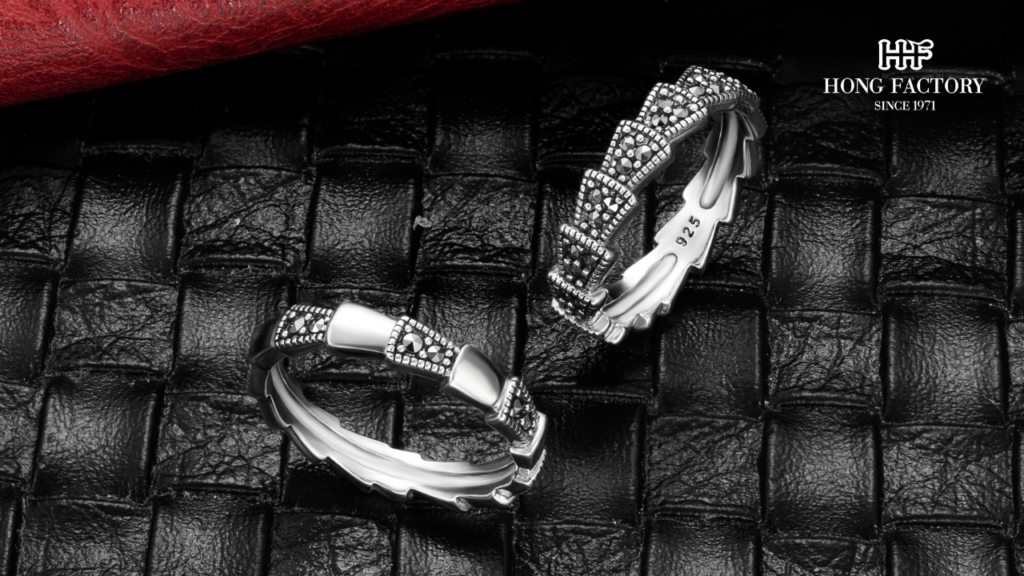
The alternative entry point is the chevron ring — a single V-shaped band of marcasite pavé that creates a strong directional line across the finger. Slimmer and more linear than the cluster ring, the chevron suits fingers that benefit from elongation and personalities that prefer a quieter geometric statement.
The Earring Pair: Fan Drop or Geometric Stud
The 2026 Art Deco earring choice has two primary expressions:
For maximum impact: The fan drop — a geometric panel of marcasite suspended below a simple post, typically 3–5cm in length. Worn with hair up or pulled back, against simple clothing. The earring becomes the complete visual statement of the look.
For every day: The hexagonal cluster stud — a hexagonal pavé setting at 12–14mm, sitting close to the ear. Visible at close range as a considered geometric choice; discreet at distance; appropriate at every occasion from morning to evening. The most versatile Art Deco earring in the collection.
The Necklace: One Geometric Pendant
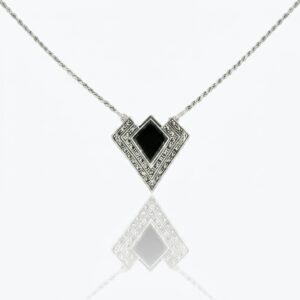
The Art Deco necklace principle is restraint carried to its logical conclusion: one pendant, geometrically precise, on a fine chain. Nothing else.
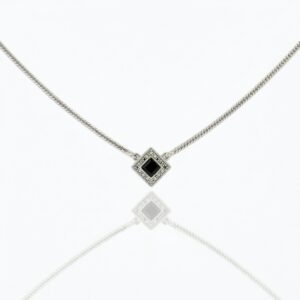
A hexagonal or octagonal marcasite pendant — 2–3cm across — on a silver trace chain at 16 or 18 inches. Worn at the base of the throat, above the neckline of a shirt or dress. The pendant sits in a zone of maximum visibility without competing with the face.
For more significant occasions: the Art Deco collar — a continuous arrangement of geometric marcasite elements that sits at the base of the throat. This is the statement necklace that requires nothing else. Simple gown, Art Deco collar, no other jewelry.
The Complete Art Deco Look
For buyers building a range, or wearers building a wardrobe, the Art Deco complete look — ring, earrings, necklace — is a coherent three-piece composition that demonstrates the aesthetic at its most powerful.
The structured professional: Hexagonal cluster ring + geometric stud earrings + geometric pendant necklace. Worn with tailored clothing in navy or grey. The complete look of a person who has thought carefully about every choice and made the right one.
The evening statement: No ring or simple band + fan drop earrings (long version) + nothing else. Against a plain black gown or simple silk dress. One strong geometric statement, fully visible, earning the occasion.
The relaxed intellectual: Chevron ring (worn alone) + hexagonal studs + teardrop marcasite pendant. The Art Deco aesthetic expressed at lower volume — still entirely legible to anyone who can read it, but carried more quietly.
How to Style Art Deco Marcasite Jewelry
With Minimalist Fashion
Art Deco jewelry was designed for clothing that provides a neutral backdrop — and minimalist fashion is the contemporary expression of that backdrop. A plain silk shirt, a simple cashmere sweater, a clean-cut dress in a single colour: these are the garments that allow a geometric marcasite piece to speak at full volume.
The rule for Art Deco with minimalist fashion: let the jewelry do the work. The clothing should be chosen to facilitate the jewelry, not to compete with it. If the necklace is the point of the look, the shirt should be the kind of thing that makes the necklace visible. If the ring is the focus, the sleeve should give it a clean frame.
With Tailored Suiting
The geometric precision of Art Deco and the structural precision of tailored suiting share the same aesthetic DNA — both are celebrations of form, proportion, and the discipline of constraint. They belong together.
A tailored blazer worn with a geometric marcasite ring and understated stud earrings creates the kind of complete, considered look that has no wrong note. Every element belongs to the same sensibility. The result reads as inevitable rather than assembled.
With Simple Evening Wear
A plain evening gown — column silhouette, minimal embellishment — with an Art Deco collar necklace is the most powerful Art Deco evening look available. The simplicity of the dress gives the necklace its fullest possible expression. The architectural quality of both pieces — the structured gown, the geometric collar — creates a composition that is simultaneously modern and deeply historical.
For those who prefer their evening jewelry at the ear rather than the throat: a pair of long Art Deco geometric drops against simple hair, with nothing else. The same principle — one strong geometric statement, maximum visual space, nothing competing.
The Colour Question
Art Deco’s tonal palette — built on the contrast of bright and dark, silver and shadow — is most at home with clothing in the cooler, darker range of the colour spectrum. Navy, black, charcoal, slate, deep ivory — these are the natural partners for sterling silver jewelry from Thailand in the Deco tradition.
Warm colours — camel, rust, terracotta, gold-toned neutrals — create a tension with the cool silver palette that can be interesting when deliberate. One warm garment against cool silver jewelry creates a chromatic conversation. But the Art Deco aesthetic’s natural register is cool, and cooling the clothing palette tends to strengthen the jewelry’s visual authority.
The one exception: a deep, jewel-like warm colour — burgundy, midnight blue verging toward purple, forest green — shares the period’s love of rich, saturated contrast and pairs beautifully with geometric marcasite.
For Wholesale Buyers: The Art Deco Opportunity in 2026
For boutique owners and wholesale buyers building or refreshing a marcasite jewelry range, the 2026 Art Deco revival is one of the clearest commercial opportunities in recent memory.
The Design Depth Is Already There
Unlike trend-driven categories that require manufacturers to develop entirely new design libraries in response to a moment, Art Deco antique silver jewelry has been in continuous production at Hong Factory since our founding. Our collection includes hundreds of geometric, Deco-inspired designs across every jewelry category — rings, earrings, necklaces, bracelets, brooches — at every price point and scale.
The 2026 revival does not require a new product development cycle. It requires knowing which pieces to bring forward.
The Story Sells Itself
Art Deco is one of the most readily storytellable design traditions available to a boutique jewelry retailer. The period’s cultural context — the 1920s, Jazz Age Paris, the celebration of the modern — is widely known and romantically appealing. The aesthetic vocabulary — the hexagon, the fan, the geometric precision — is specific enough to be identified and named by customers without specialist knowledge.
A retail staff member who can say “this is Art Deco — the geometric tradition from 1920s Paris, translated into Thai silver by craftspeople who have been making it for fifty years” is giving the customer a story, a context, and a reason to buy that price and appearance alone cannot provide. The story is already there. Use it.
What to Stock
For buyers building an Art Deco focus in their 2026 range, the priority designs are:
Hexagonal cluster rings in two to three size variations — the statement cocktail and the more restrained everyday. Together they create a natural price range within a single design family.
Fan drop earrings in two lengths — the everyday 3cm drop and the occasion 5cm statement drop. Different pieces for different contexts, building to a complete earring wardrobe within one design direction.
Geometric pendant necklaces — hexagonal, octagonal, and step-form designs on fine chains. These are the everyday necklaces that the Art Deco buyer returns for repeatedly.
Chevron and step-cut bands — slim, directional ring bands that stack naturally with the hexagonal cluster and create Art Deco stacking possibilities.
Statement collar necklaces — one or two pieces at the premium tier. Display at the focal point of the Art Deco section even if they are not your highest-volume pieces. Their presence elevates everything around them.
Frequently Asked Questions
Is Art Deco jewelry appropriate for young buyers, or is it only for older customers? The 2026 revival is being driven primarily by younger buyers — the 25–40 demographic that came to design literacy through social media, museum culture, and the broader quiet luxury conversation. Art Deco is not an age-specific aesthetic. It is a design intelligence aesthetic, and that intelligence is not correlated with age.
How do I explain Art Deco to customers who are not familiar with the term? Start with what they can see: “The geometric shapes, the precise patterns — this design style comes from 1920s Paris. It was the era of the Great Gatsby, Jazz Age fashion, the celebration of modern design. The hexagon, the fan, the precise setting of stones — these are all Art Deco signatures.” Most customers respond with immediate recognition. The cultural references are almost universally known.
Can Art Deco marcasite jewelry be worn with contemporary fashion, or does it look costume? Art Deco marcasite wears as contemporary rather than costume when paired with simple, modern clothing. The risk of “costume” arises when the jewelry is combined with explicitly retro or period-specific fashion — then the two historical references compete and create a costume effect. With clean, contemporary minimalist clothing, the geometric precision of Art Deco reads as strikingly modern.
What is the wholesale minimum for Art Deco marcasite designs from Hong Factory? Ready stock orders start from USD 1,000 with no per-design minimum. Made-to-order production starts from USD 2,000 with a minimum of 5 pieces per design and a 30–45 day lead time. Our wholesale team can advise on the Art Deco designs that have performed most strongly in comparable markets.
The Moment Is Now
The Art Deco revival of 2026 is not a moment to observe from a distance. It is a moment to act on — because the cultural conditions that created it (the preference for precision, the silver resurgence, the design-literate consumer, the quiet luxury aesthetic) are structural rather than cyclical. This is not a trend that will peak and collapse. It is a cultural realignment toward the values that Art Deco has always embodied: craft, precision, restraint, and the deep satisfaction of a geometric form resolved perfectly.
Hong Factory has been producing antique silver jewelry and vintage marcasite jewelry in the Art Deco tradition since 1971. For buyers who want to take advantage of the 2026 moment, our collection is ready.



Jewelry Blog
Hallmarks and Stamps: How to Verify Authentic Sterling Silver
Buying Sterling Silver jewelry is an investment in quality, [...]
Jul
Sterling Silver 925 vs Silver Plated: How to Spot the Difference
If you’ve ever shopped for silver jewelry, you’ve probably [...]
Jul
What Is Marcasite? The Complete Guide for Jewelry Retailers
Marcasite jewelry has remained a timeless favorite for decades, [...]
Jul
Red Hot: Why Ruby-Toned Jewelry Is Trending This Summer
This summer, bold color is taking center stage—and nothing [...]
Jul
How Marcasite Stones Are Hand-Set into Sterling Silver
The art of setting Marcasite Stones into sterling silver [...]
Jul
OEM vs ODM: Which Jewelry Manufacturing Model Fits Your Brand?
In today’s competitive global market, choosing the right Jewelry [...]
Jul
Men’s Silver Jewelry Line: An Untapped Wholesale Opportunity
In today’s evolving fashion landscape, men’s accessories are no [...]
Jul
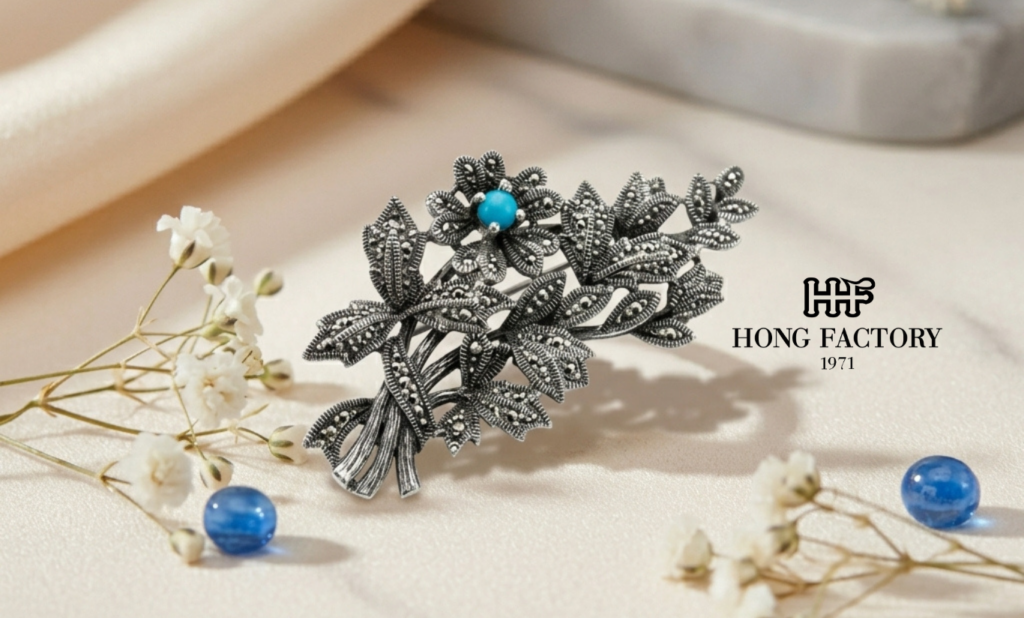
Marcasite Brooch Revival: Vintage Style Meets Modern Wholesale Demand
In the ever-evolving world of fashion jewelry, trends often [...]
Jul