
Rings are seen at close range. Necklaces are seen at medium distance. Earrings are seen from across the room, they are in every photograph, they frame the face in every conversation, and they are the first thing a well-attuned observer notices when they look at you. Everything else is supporting cast. Earrings are the lead.
Marcasite earrings understood this before you did. The dark, complex sparkle of marcasite — the way it catches light from multiple angles, the way its tonal depth creates visual interest that simpler materials cannot match — makes it one of the most face-flattering earring materials available. It sparkles without blinding. It has depth without being heavy. It has historical resonance without being costume.
But knowing that marcasite earrings are beautiful is not the same as knowing how to wear them well. This guide makes the second part as clear as the first.
Understanding the Marcasite Earring Family
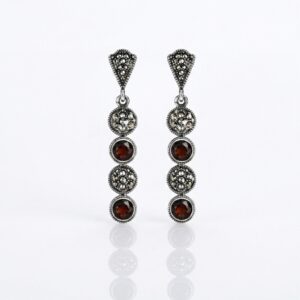
Before styling principles, the range. Marcasite earrings span an enormous distance — from the smallest dainty stud to the most elaborate multi-tier chandelier — and the styling logic for each is different. Understanding where each type lives in the earring vocabulary is the foundation of wearing them well.
Studs: The Foundation
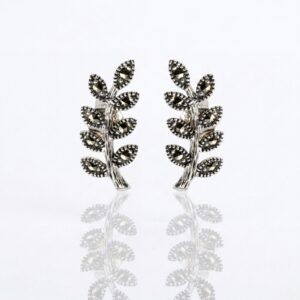
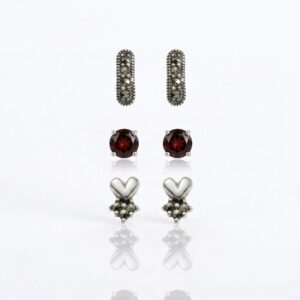
Marcasite studs are the foundational earring of any well-built jewelry wardrobe. They sit close to the ear, they travel well, they cause no discomfort over long wearing periods, and they work in contexts where drop earrings would be excessive — the morning meeting, the plane journey, the day that becomes an evening without warning.
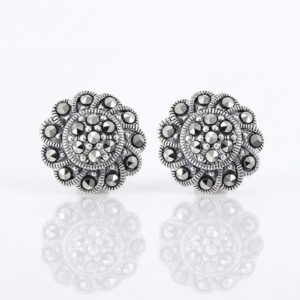
But “simple” does not mean insignificant. A well-made marcasite pavé stud — 10–14mm across, densely set, with the characteristic oxidised silver depth behind the stones — is not a compromise earring. It is a considered choice. The person across the table from you sees discretion; the person sitting beside you sees extraordinary craft.
Dainty marcasite jewelry in stud form — the tiny pavé cluster, the single-stone setting, the delicate flower with a stone-set centre — operates in the same register but at a smaller scale. These are the earrings worn by someone who believes jewelry should be felt as much as seen: present, personal, and entirely their own.
Drops: The Versatile Middle Ground
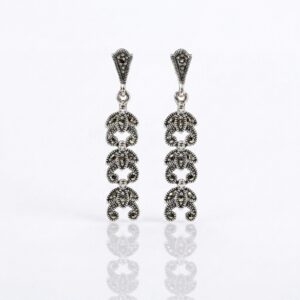
Drop earrings — a pendant element suspended below a stud or post fitting — occupy the most commercially and stylistically versatile territory in the marcasite earring range. They are more visible than studs but less demanding than chandeliers. They work for day or evening depending on their scale and complexity. They move with the wearer, catching light at different angles as the head turns.
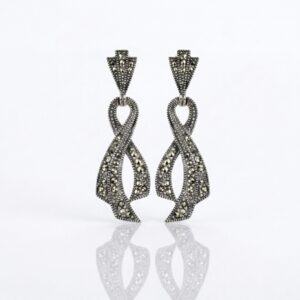
The teardrop, the Art Deco fan, the geometric panel, the simple marcasite oval — drop earring forms in the vintage marcasite tradition are among the most consistently beautiful designs in the collection. Each has its own character and its own optimal context.
Chandeliers and Statement Drops: The Event Earrings
Chandelier earrings — multi-tier, complex, substantial in visual presence — are the earrings that announce an occasion. They are not everyday earrings. They are not office earrings. They are the earrings that require a context worthy of them: an evening out, a wedding, a dinner where the lighting is right and the company is equal to the pieces.
Lightweight marcasite jewelry technology has changed the chandelier equation significantly. Designs that once required substantial metal to support their visual complexity can now be produced with fine silver structures that keep the physical weight comfortable even over long wearing periods. This matters for chandeliers specifically, where weight fatigue — the cumulative discomfort of heavy earrings over several hours — has historically been a wearing deterrent.
Part One: Styling Marcasite Studs
The Everyday Stud
The everyday marcasite stud has one styling principle above all others: wear it with everything, always. This is not a piece that needs a pairing strategy. It is a piece that improves every outfit it accompanies — not by adding drama but by adding the quiet signal of considered personal style.
That said, the everyday stud does its best work in specific contexts:
With pulled-back hair. A stud earring that is not visible is a stud earring that is wasted. Wearing hair up, pulled back, or behind the ears gives the marcasite stud the visual access it needs to be appreciated. A chignon, a low ponytail, or simply hair tucked behind the ears transforms the stud from background presence to considered choice.
With a clean neckline. A simple crewneck, a boat neck, a plain shirt — the stud earring works best when the neck and jaw are uncluttered. A busy collar, a statement necklace, or a high turtleneck reduces the visual territory available to the earring and dilutes its effect.
In multiples. The multiple-piercing trend has given stud earrings a new dimension of possibility. A composition of three or four dainty marcasite jewelry studs in different sizes — worn in ascending piercings from lobe to upper ear — creates a composed, layered effect that is genuinely distinctive. The key is consistency of material (all marcasite, all oxidised silver) with variation of size and form.
Stud Size as Style Signal
The size of a marcasite stud communicates as clearly as its design. Understanding the signal each size sends helps you choose deliberately.
8–10mm studs: The dainty end of the range. Close to the ear, barely there at distance. These are the studs that make a statement through presence and material quality rather than scale. They work at every occasion from the most casual to the most formal, and they are the right choice when everything else in the outfit is doing work — when the clothing is the statement and the jewelry should support rather than compete.
10–14mm studs: The sweet spot. Large enough to be immediately visible, small enough to work across contexts. The most versatile stud size in the marcasite range and the most consistently purchased. If you are building a stud wardrobe and starting from zero, begin here.
14mm and above: Statement studs. At this scale, a marcasite stud begins to function less like a background detail and more like a design choice that requires the outfit to acknowledge it. These studs work beautifully with simple, minimal clothing where the earring is the focal point of the look. They are less comfortable in contexts where the clothing itself is complex or pattern-heavy.
Stud Composition: Shape and Form
The shape of a marcasite stud determines its aesthetic register and its compatibility with face shape.
Round cluster studs: The most universally flattering form. A circular composition of set marcasite has no directional emphasis — it works with every face shape and every styling context. The default choice when you are not sure what to choose.
Oval studs: Gently elongating. Slightly more formal than round, slightly more movement-suggestive. Works particularly well with square and round faces where vertical elongation is flattering.
Hexagonal and geometric studs: Art Deco in reference. The sharp edges and precise geometry suit angular faces and structured clothing. They read as contemporary and design-literate in a way that more organic forms do not.
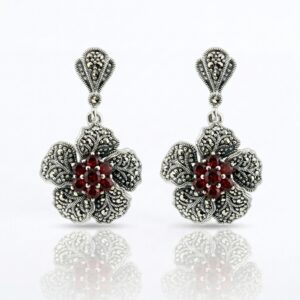
Floral studs: Victorian in reference. The organic, radiating form of a floral cluster with a coloured stone centre has a warmth and approachability that geometric forms lack. Universally flattering, widely appealing, and the most gift-appropriate stud form in the range.
Square studs: Modern, precise, architectural. The most minimal of the geometric options — a simple square of marcasite pavé is quiet luxury in stud form.
Part Three: Styling Chandelier and Statement Earrings
Reading the Room: When Chandeliers Are Right
The most important styling principle for chandelier and statement marcasite earrings is one of context rather than technique: these earrings require an occasion. Not in the sense of a formal event specifically, but in the sense of a context where visual presence is appropriate and welcomed — where being noticed for what you are wearing is a pleasure rather than an inconvenience.
An evening dinner. A wedding attended as guest. A gallery opening. A cultural event where the audience is dressed with intention. These are chandelier contexts.
The morning commute, the video call, the working lunch — these are not. Not because chandeliers cannot technically be worn in these contexts, but because the earring will spend the entire time at war with its environment, and that war is not a war the earring wins. The right piece in the wrong context is the wrong piece.
The Victorian Chandelier
A multi-tier Victorian chandelier — cascading floral or foliate marcasite elements suspended from a central fitting — is one of the most spectacular earring designs in the vintage silver tradition. Its movement is part of its appeal: the individual elements respond to the wearer’s movement, creating a dynamic sparkle that changes with every gesture.
Styling the Victorian chandelier:
Hair must be worn up for a chandelier of any real scale. The earring needs the neck and jaw fully visible to have its effect — and it needs the ear visible as the anchor point from which it descends.
The outfit should be simple. A plain evening gown, a clean structured dress, a beautifully cut silk top — the clothing provides the context and the chandelier provides the event. Resist the urge to wear other significant jewelry simultaneously: a statement necklace competes with a chandelier earring, and the competition produces visual noise rather than composed elegance.
Skin care and face framing matter more with chandelier earrings than with any other piece. These earrings are close to the face, move with the face, and draw the eye directly to the face. Ensure the complete look is considered before the earrings are the last thing added.
The Art Deco Statement Drop
The Art Deco statement drop — a long geometric panel, a significant fan, a stepped linear form — is the more architectural and restrained alternative to the organic Victorian chandelier. It shares the statement earring’s occasion requirements but has a different aesthetic register: cool and precise rather than warm and decorative.
The Art Deco statement drop suits professional occasions — an awards dinner, a significant client meeting, a formal work event — where the Victorian chandelier might feel slightly too purely decorative. Its geometric authority reads as considered rather than festive.
The Multi-Piercing Approach: Composing an Ear
The single-earring-per-ear orthodoxy has relaxed significantly in the last decade, and the result — for marcasite earring wearers specifically — has been the emergence of one of the most interesting styling possibilities in the contemporary jewelry vocabulary: the composed ear.
A composed ear is an intentional arrangement of multiple earrings — studs and drops combined across multiple piercings — that functions as a single unified composition rather than as independent pieces.
For dainty marcasite jewelry and lightweight marcasite jewelry specifically, the composed ear creates possibilities that single-earring wearing does not. A small dainty stud at the upper lobe, a medium cluster stud at the standard lobe position, and a tiny cartilage stud above — all in marcasite, all in oxidised silver — creates a composition with visual rhythm and depth that no single earring can match.
Principles for Composing a Marcasite Ear
Consistent material language: Every piece in the composition should share the marcasite and oxidised silver palette. Mixing metals or stone types within a single ear composition creates visual noise. Consistent material with variation in size and form creates coherence.
Descending scale: The conventional approach — largest piece at the lobe, progressively smaller pieces ascending — creates a natural visual hierarchy that reads as composed rather than random. Work against this convention only deliberately.
Odd numbers: Three pieces per ear read as more natural and less symmetrical than two or four. Three is the composition number for most ear arrangements — though this is a guideline, not a rule.
Leave space: The composed ear does not require every piercing to be filled. Leaving some piercings empty creates the negative space that makes the occupied ones more visible. The most sophisticated composed ears use restraint as deliberately as they use presence.
Face Shape and Earring Form: A Practical Reference
The most useful application of face-shape awareness in earring selection is not about following rules — it is about understanding the effect each earring form creates and using that effect deliberately.
Round face: Elongating forms — teardrops, geometric panel drops, long Art Deco fans — create vertical emphasis that balances the horizontal breadth. Avoid wide, horizontal studs that add visual width to the jaw.
Square face: Curved and organic forms — round cluster studs, oval drops, Victorian floral elements — soften the angular jaw. Avoid very rigid geometric forms that mirror the jaw’s angularity.
Oval face: The most versatile face shape for earring selection. Almost any form works. Use this freedom to choose based on occasion and outfit rather than face-shape correction.
Heart face: Wider forms at the ear level — broad studs, fan shapes that expand downward — balance the narrow jaw. Teardrops and elongated drops suit the heart face less well than rounder, broader forms.
Long face: Horizontal emphasis and round or wide forms — broad studs, wide fan drops — create the visual width that balances a long face. Avoid long drops that add further vertical length.
Caring for Marcasite Earrings
Because earrings are close to the face, they are exposed to more skincare product, hairspray, and perfume contact than almost any other jewelry item. This makes specific care practices particularly important.
Put earrings on last. Perfume, hairspray, and styling products should be fully applied and dried before earrings are put in. These products accelerate silver tarnishing and can affect the oxidised finish that gives marcasite earrings their characteristic depth.
Clean after wearing. A soft dry cloth wiped gently across the surface after each wearing removes skin oils and product residue before they can accumulate. For more thorough cleaning, a very soft dry brush (a clean mascara wand or soft toothbrush, dry) removes debris from pavé settings without displacing stones.
Check fittings regularly. Post fittings and butterfly backs on earrings receive significant daily use. Check that butterfly backs are secure and replace them if they have become loose — a lost earring from a worn-out back is a preventable loss.
Store carefully. Earrings stored loose in a box will scratch each other and catch on other pieces. Individual pouches, earring holders, or a lined tray with separate compartments protects both the pieces and the oxidised finish.
Check stone security periodically. In pavé-set marcasite, individual stones can occasionally loosen with impact or wear. Press each stone gently with a fingernail — any movement indicates it needs professional attention before the stone is lost.
Building a Marcasite Earring Wardrobe: Where to Start
For buyers building a marcasite earring range — or individuals building a personal collection — the progression from foundation to complete wardrobe follows a practical sequence.
First: One versatile everyday stud in the 10–14mm range. Round cluster or floral cluster with coloured stone. Wear it for a month. Let it tell you what it needs.
Second: One drop earring in the versatile middle range — teardrop or small fan drop. This gives you a second register — slightly more presence than the stud, still appropriate for most contexts.
Third: One coloured-stone drop for occasions and gift giving. Victorian floral drop with garnet or amethyst. This is the earring that generates compliments and demonstrates the range of what marcasite can do.
Fourth onwards: Build towards the composed ear with small dainty studs for upper piercings. Add a statement drop for evenings. Fill in the gaps that your wearing habits reveal.
Frequently Asked Questions
Can marcasite earrings be worn every day? Absolutely — the right piece for the right context. Marcasite studs and simple drop earrings are designed for regular wear. The 925 sterling silver and properly set marcasite stones are durable enough for daily use with appropriate care.
Are marcasite earrings heavy? At Hong Factory, we produce lightweight marcasite jewelry using fine silver construction techniques that minimise the physical weight of the piece while maintaining visual presence. Most stud and small drop earrings are extremely comfortable for extended wear. For larger chandelier designs, we recommend trying the earring for an hour before committing to a long occasion.
What is the difference between dainty marcasite earrings and standard marcasite earrings? Scale and weight. Dainty marcasite earrings are produced on finer shanks and smaller frames, with a delicacy that suits multiple-piercing wearing and understated styling. Standard-scale pieces carry more visual presence and suit contexts where the earring is meant to be seen clearly.
Can I wear marcasite earrings with other materials — gold, pearls, mixed metals? Yes. The cool, dark quality of oxidised Thai silver creates effective contrast with warm materials like gold and pearl. The principle is: one dominant material and one accent. A pearl and marcasite combination — a pearl stud in one lobe and a marcasite drop in another — is a beautiful composed ear option.
What is the minimum wholesale order for marcasite earrings from Hong Factory? Ready stock orders start from USD 1,000 with no per-design minimum — ideal for building a diverse earring display. Made-to-order production starts from USD 2,000 with a minimum of 5 pieces per design and a 30–45 day lead time.
Find Your Marcasite Earring Story with Hong Factory
Hong Factory produces hundreds of marcasite earring designs — from the smallest dainty marcasite jewelry studs to the most elaborate lightweight marcasite jewelry chandeliers — in 925 sterling silver, hand-set by skilled craftspeople in Bangkok.
Whether you are sourcing for a boutique, building a personal collection, or looking for pieces that earn their place in every outfit, our collection offers the breadth of design and the consistency of quality that marcasite earrings deserve.



Jewelry Blog
Coloured Gemstone Silver Jewelry: the Biggest Trend Hitting Boutiques in 2026
After years in which the dominant aesthetic conversation in [...]
Jun
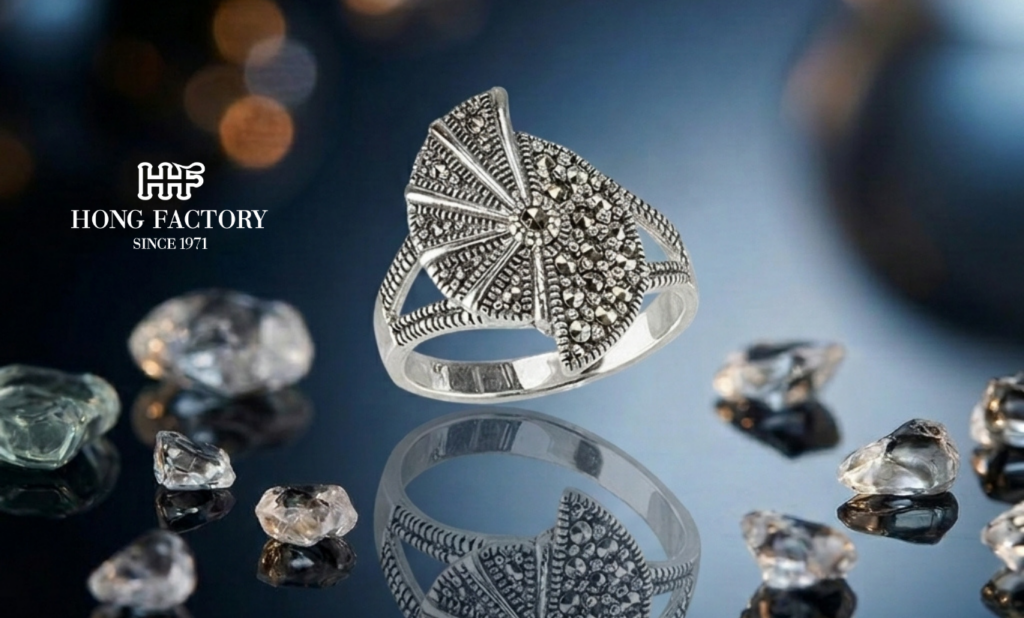
Art Deco Jewelry Is Back: Why the Geometric Silver Look Is Dominating 2026 Fashion
Walk the floors of any major jewelry trade show [...]
May
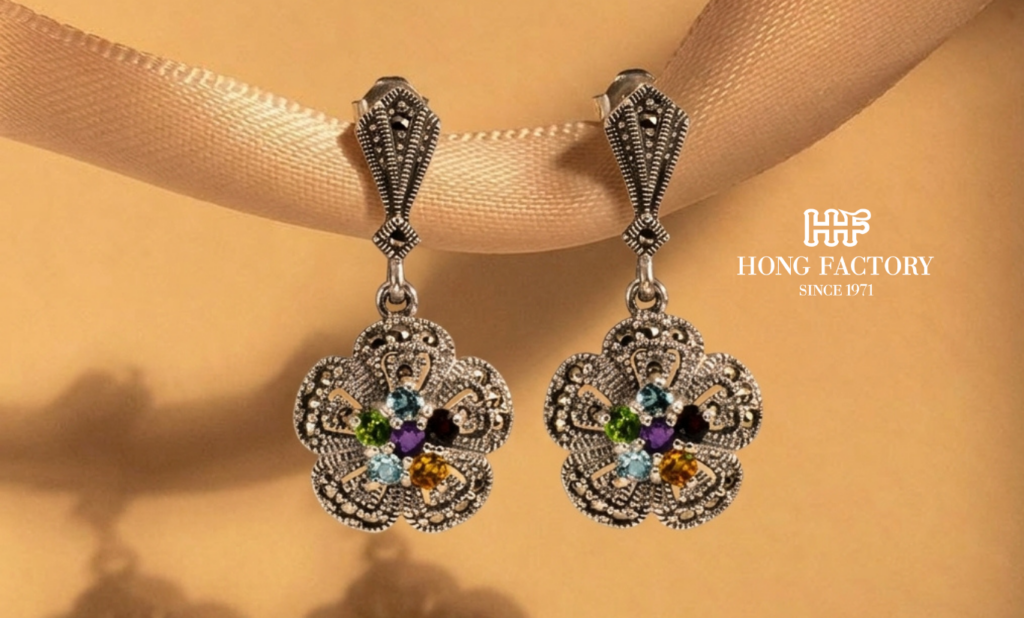
How to Style Marcasite Earrings: From Minimal Studs to Statement Drops
Rings are seen at close range. Necklaces are seen [...]
May
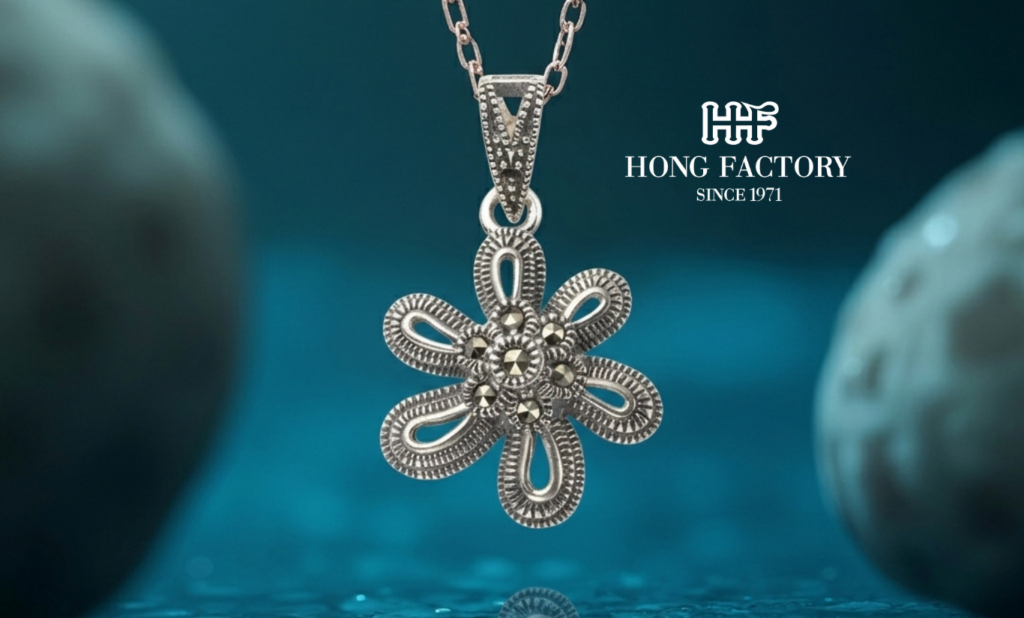
Old Money Aesthetic and Silver Jewelry: Why Marcasite Is the Quiet Luxury Choice
It is not because the pieces are large — [...]
May
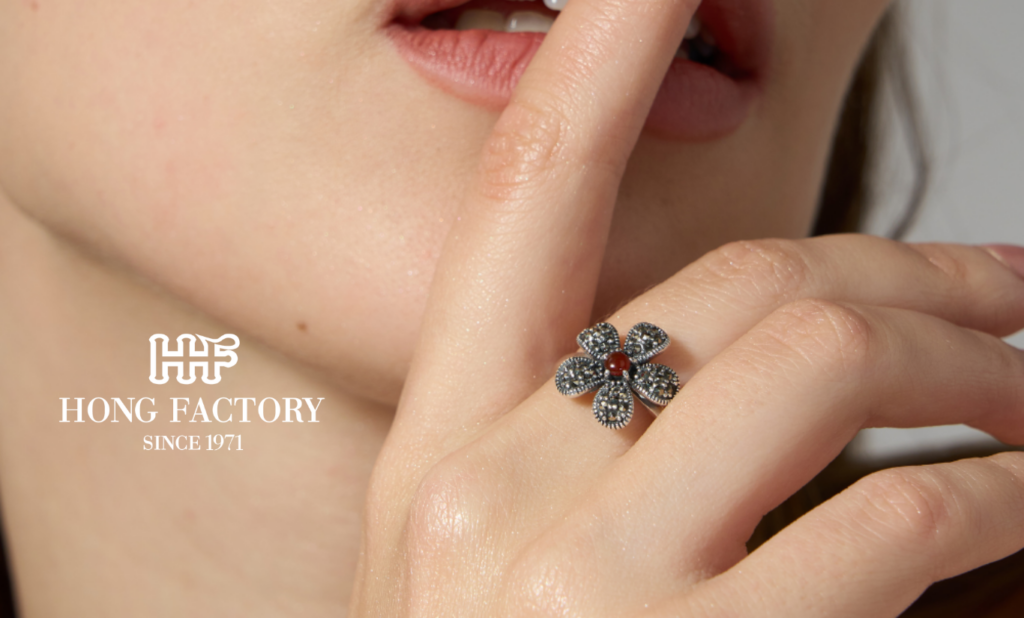
Silver Jewelry Outfit Pairing Guide: Which Pieces Work with Every Wardrobe
The most common jewelry mistake is not wearing the [...]
May
The Art of Stacking: How to Mix Marcasite Rings for Every Finger
There is a moment that every ring stacker knows. [...]
May
Vintage-Inspired Bridal Jewelry: Why More Brides Are Choosing Marcasite Over Diamonds
For decades, the bridal jewelry script was fixed: diamond [...]
May
Top 10 Bestselling Marcasite Jewelry Designs from Hong Factory in 2026
Every season, our wholesale team tracks sell-through data from [...]
May